
Every name tells a story. Greek last names are more than just names; they represent thousands of years of Greek culture, ancient traditions, religious influences, and family heritage. These surnames reflect the history, identity, and values passed down through generations. If you are searching for the meaning behind a Greek family name, choosing a surname for a character, or exploring a famous celebrity’s last name, this guide will provide valuable insights.
This complete guide explores Modern Greek last names, including their history, meanings, origins, pronunciation, and popularity. You will discover how Greek last names’ meaning connects with occupations, physical traits, hometowns, and family backgrounds. It also explains patronymic surnames, how Greek surnames were created, and how Greek family names evolved over time. By the end, you will understand their origins, correct pronunciation, and the most common Greek surnames today.
The Rich History and Meaning Behind Modern Greek Last Names
Greek surnames (last names) did not always exist; they developed slowly over time from personal identifiers into family names that were passed down through generations. Greek surnames are deeply connected to Greece’s long and rich history.
Ancient Greece, one of the most influential civilizations in the world, originally used only personal names for identification. During that time, people were known only by their first names, and family names did not exist. As society grew and families became more established, the need for surnames gradually increased.
Greek last names are not just names; they represent a family’s history, professions, places of origin, and old traditions. Understanding the history behind these surnames makes it easier to discover their true meanings and the stories connected to them.
| Historical Period | Naming Practice |
| Ancient Greece (500–300 B.C.) | Single given names only |
| 11th–12th Century | Upper-class families adopt surnames |
| Byzantine Era | Noble family names (e.g., Doukas, Palaiologos) emerge |
| Modern Greece | Fixed, inherited Greek family names become standard |
Understand How Greek Last Names Originated
Most Greek surnames were built directly from a father’s first name, turning identity into a family legacy.
The majority of Greek last names meaning something specific trace back to patronymic surnames — names formed by adding a suffix to a father’s first name. This naming tradition helped people identify which family or lineage a person belonged to, even before official records and registries existed. Understanding the origin and meaning behind such names is similar to exploring the history behind different naming traditions, such as those found in character and unique name collections like Assassin Names Guide.
Beyond patronymics, Greek surnames also developed from three other major sources:
- Occupational names – based on a person’s job (e.g., a butcher, a priest, a shoemaker)
- Place-based names – based on a village, region, or geographic feature
- Nickname-based names – based on a physical trait or personality feature
This is exactly how Greek last names were created, and understanding these four categories — patronymic, occupational, geographic, and nickname-based — makes it much easier to decode any Greek surname you come across.
Learn the Meaning Behind Common Greek Surname Suffixes
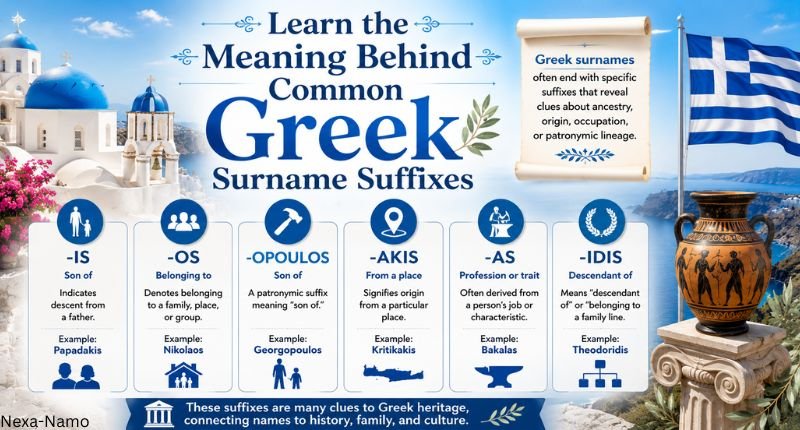
A single suffix can completely change the meaning of a Greek surname, often translating directly to “son of” or “descendant of.”
If you’ve ever wondered why so many Greek surnames end the same way, the answer lies in regional suffixes. These endings are one of the clearest ways to understand Greek last names’ meaning at a glance.
| Suffix | Meaning | Common Region | Example |
| -opoulos | “Son of” / “descendant of” | Peloponnese | Papadopoulos |
| -akis | Diminutive, “child of” | Crete | Petrakis |
| -idis / -iadis | “Son of” | Pontus / Northern Greece | Nikolaidis |
| -atos | “Belonging to” | Cephalonia | Metaxatos |
| -ou | “Of” (possessive) | General Greece | Christoforou |
The -opoulos surname meaning almost always points to lineage — for instance, Theodoropoulos translates to “son of Theodoros.” Meanwhile, the -akis surname meaning carries a softer, affectionate tone, often translated as “little” or “child of,” which is why it remains especially popular in Crete.
Explore Regional Differences in Greek Surnames
Where a family originally settled in Greece often determines exactly how their surname is spelled and structured.
Greece is divided into distinct regions — the mainland, the islands, Peloponnese, Crete, and Cyprus — and each area developed its own naming preferences over centuries.
| Region | Typical Suffix | Example Surnames |
| Peloponnese | -opoulos | Alexopoulos, Angelopoulos |
| Cretan surnames | -akis | Xenakis, Paterakis, Sifakis |
| Northern Greece / Pontus | -idis | Nikolaidis, Petridis |
| Cephalonia / Ionian Islands | -atos | Metaxatos, Lakerdatos |
| Cyprus Greek surnames | -ou / distinct patterns | Christoforou, Georgiou |
Cyprus Greek surnames often differ slightly from mainland Greek names because of the island’s unique political, cultural, and historical influences. On the other hand, Cretan surnames are among the most recognizable Greek family names, especially because of their distinctive “-akis” ending. These regional differences show how Greek surnames have evolved over time, similar to the way different cultures develop unique and meaningful family names, as seen in collections of Pretty Last Names.
Find Out Why Greek Women Kept Their Maiden Names
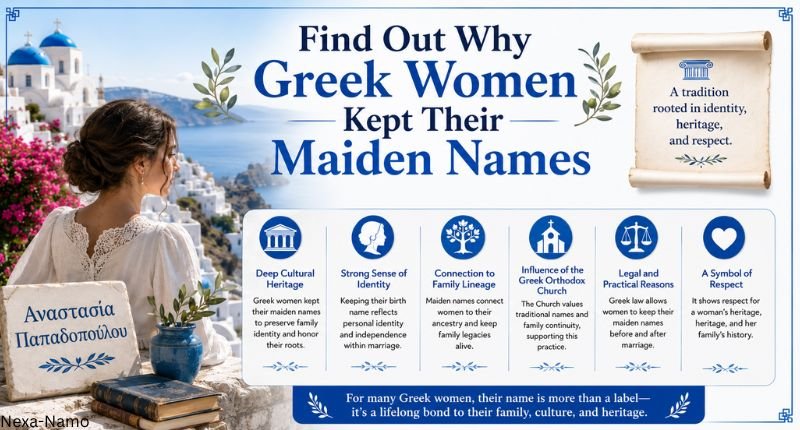
The Greek women’s surname system has changed significantly over time. Before the 1980s, a woman’s identity was often connected to her father’s or husband’s name through Greek surnames. Before marriage, women used a feminine version of their father’s surname, and after marriage, they adopted a feminine version of their husband’s surname. This tradition meant that a woman’s identity was closely linked to her male family members.
In 1983, Greece introduced a new law that changed the way Greek women’s last names were handled. Influenced by the feminist movement, the law allowed women to keep their birth surname (maiden name) permanently. Today, the answer to do Greek women change their surname after marriage is no, as Greek women legally keep their original surname even after marriage, protecting their personal identity and family heritage.
Pronounce Greek Last Names the Right Way
Getting the stress and syllables right can make all the difference when saying a Greek surname out loud.
Knowing how to pronounce Greek surnames correctly shows respect for the culture and avoids common mispronunciations. Here’s a simple phonetic guide for some of the most searched names:
| Surname | Phonetic Pronunciation |
| Papadopoulos | pah-pah-THOH-poo-los |
| Georgiou | yeor-YEE-oo |
| Karagiannis | ka-ra-YAN-nis |
| Nikolaidis | nee-koh-LAI-dees |
| Vasiliou | va-see-LEE-oo |
A general rule: Greek surnames often stress the second-to-last syllable, and the letter combination “ou” is pronounced as a single “oo” sound.
Browse the Most Popular Greek Last Names and Their Meanings
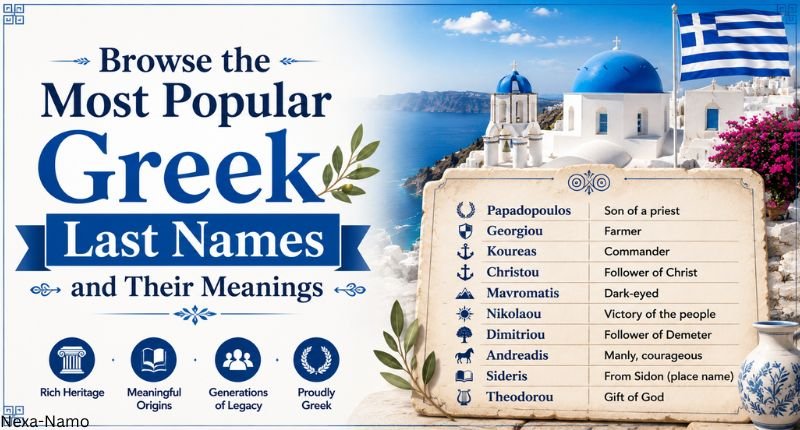
These are the surnames you’re most likely to encounter, whether in Greece, the diaspora, or pop culture.
Below is a list of the most common Greek last names, widely used across Greece and among Greek communities worldwide.
| # | Name | Meaning | Gender Use |
| 1 | Papadopoulos | Son of a priest | Unisex (family name) |
| 2 | Georgiou | Son of George / farmer | Unisex |
| 3 | Dimitriou | Son of Dimitrios | Unisex |
| 4 | Ioannou | Son of Ioannis (John) | Unisex |
| 5 | Katsaros | Curly-haired | Unisex |
| 6 | Kritikos | The Cretan | Unisex |
| 7 | Vasiliou | Son of Vasilis (king) | Unisex |
| 8 | Nikolaou | Son of Nikolaos | Unisex |
| 9 | Angelopoulos | Son of the angel/messenger | Unisex |
| 10 | Petridis | Son of Petros (rock) | Unisex |
| 11 | Athanasiou | Son of Athanasios (immortal) | Unisex |
| 12 | Anagnostopoulos | Son of the church reader | Unisex |
| 13 | Kotsopoulos | Descendant of Kotsos | Unisex |
| 14 | Zervas | Left-handed | Unisex |
| 15 | Chronopoulos | Son of time / Chronos | Unisex |
| 16 | Sarantopoulos | Son of the fortieth | Unisex |
| 17 | Karamanlis | From Karaman region | Unisex |
| 18 | Michalopoulos | Son of Michalis (Michael) | Unisex |
| 19 | Alexopoulos | Son of Alexios (defender) | Unisex |
| 20 | Kostopoulos | Son of Kostas (steadfast) | Unisex |
These common Greek last names are so widespread today because they originated from popular first names, meaning generations of families independently formed similar surnames across different regions.
Uncover Unique and Rare Greek Surnames
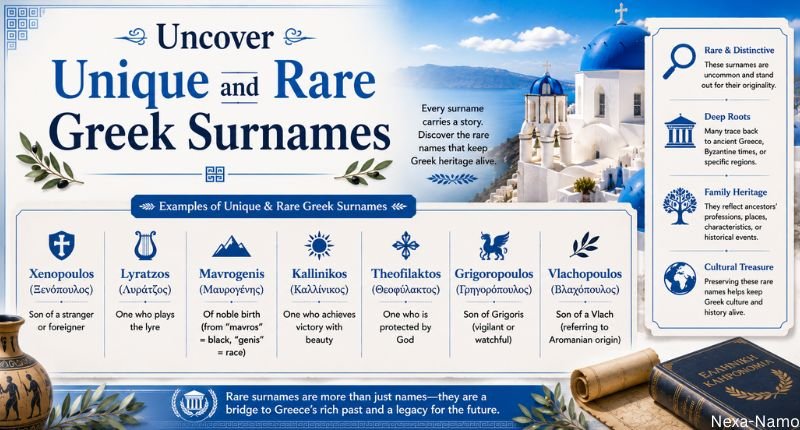
Beyond the popular names, Greece is home to surnames with striking, poetic, and sometimes unexpected meanings.
If you’re looking for unique Greek last names, these lesser-common surnames stand out for their vivid imagery and unusual origins.
| # | Name | Meaning | Gender Use |
| 1 | Xiphias | Swordfish | Unisex |
| 2 | Gataki | Kitten | Girl-leaning |
| 3 | Aetos | Eagle | Boy-leaning |
| 4 | Diamandis | Diamond | Unisex |
| 5 | Galanis | Blue eyes | Unisex |
| 6 | Loukanis | Sausage maker | Unisex |
| 7 | Onassis | Lover | Boy-leaning |
| 8 | Kontos | Short | Unisex |
| 9 | Sotiris | Savior | Boy-leaning |
| 10 | Thanos | Immortal | Boy-leaning |
| 11 | Chrysafi | Goldsmith | Unisex |
| 12 | Glaros | Seagull | Unisex |
| 13 | Kourkoulis | Hooded one | Unisex |
| 14 | Floraki | Little flower | Girl-leaning |
| 15 | Smyrnios | From Smyrna | Unisex |
These unique Greek last names rarely appear in mainstream lists, which makes them a great choice for anyone looking for a surname with real character, history, and a distinctive story. If you are searching for creative naming inspiration or something that feels different and memorable, exploring unique name ideas like Best Anonymous Username Ideas can also help you find the right style and inspiration.
Trace Ancient Greek Surnames Still Used Today
Some of the surnames carried by Greek families today can be traced directly back to ancient roots and Byzantine nobility.
Ancient Greek surnames connect modern families to a civilization that shaped philosophy, democracy, and art. Many of these names survive almost unchanged.
| # | Name | Meaning | Gender Use |
| 1 | Doukas | Duke (Byzantine noble family) | Unisex |
| 2 | Palaiologos | Old word / ancient speech | Unisex |
| 3 | Laskaris | Type of soldier (Byzantine dynasty) | Unisex |
| 4 | Iraklidis | Son of Heracles | Boy-leaning |
| 5 | Anthopoulos | Descendant of the flower | Unisex |
| 6 | Hatzis | Pilgrim to the Holy Land | Unisex |
| 7 | Lykaios | Wolf-like | Boy-leaning |
| 8 | Makris | Tall or long | Unisex |
| 9 | Economides | Steward/manager | Unisex |
| 10 | Kefalas | Head / leader | Unisex |
These ancient Greek surnames highlight how deeply intertwined family identity is with mythology, religion, and centuries-old titles of nobility.
Meet Famous People Who Carry These Greek Surnames
Some Greek surnames have become globally recognized thanks to the influential people who carried them.
Famous Greek surnames often gain international recognition through business leaders, politicians, and cultural icons:
- Onassis — made globally famous by shipping magnate Aristotle Onassis
- Karamanlis — carried by former Greek Prime Ministers
- Papadopoulos — one of the most recognized Greek surnames worldwide, including in politics and business
- Angelopoulos — associated with acclaimed filmmaker Theo Angelopoulos
- Doukas — tied to Byzantine imperial history
These famous Greek surnames show how a single family name can carry influence across politics, film, business, and history for generations.
Read more: FeetFinder Names
See the Full List of 150+ Greek Last Names A-Z
This complete alphabetical directory covers modern, popular, and traditional Greek surnames in one place.
Below is a comprehensive Greek last names A to Z list for quick reference.
| Name | Meaning |
| Adamos | Son of Adam |
| Agelastos | Never laughing / serious |
| Andreadis | Manly, courageous |
| Andris | Manly |
| Angelis | Angel, messenger |
| Anastasiou | Of the resurrection |
| Antoniou | Son of Antonios |
| Apostolos | Apostle, messenger |
| Argyros | Silver |
| Arvanitis | Of Albanian descent |
| Athanasiou | Immortal |
| Bakas | From a village named Baka |
| Bakirtzis | Coppersmith |
| Ballas | Bold one |
| Barbas | Uncle / respected elder |
| Biros | Strong |
| Booras | Northerly / from the north wind |
| Callas | Beautiful |
| Christodoulou | Servant of Christ |
| Christopoulos | Son of Christos |
| Comis | Count / noble title |
| Constantinou | Son of Constantine |
| Costas | Steadfast |
| Delis | Brave, daring |
| Demetriou | Follower of Demeter |
| Drakos | Dragon, ogre |
| Drivas | Strong, forceful |
| Economou | Steward, manager |
| Eliades | Son of Elias |
| Filo | Friend, dear one |
| Fotopoulos | Son of light |
| Frangos | Foreigner, Frank |
| Galanis | Blue-eyed |
| Galatas | From Galata |
| Georgiadis | Son of Georgios, farmer |
| Gialamas | From a coastal region |
| Giannakopoulos | Son of little Yannis |
| Glezos | Elegant, refined |
| Grivas | Grey-haired |
| Hadjiyannis | Pilgrim named Yannis |
| Hatzi | Pilgrim |
| Kalogeris | Monk-like, pious |
| Kanellopoulos | Son of Kanellos |
| Karagiannis | Black John |
| Katsaros | Curly-haired |
| Kazantzalis | Cauldron maker |
| Kokkinos | Red / red-haired |
| Kondylis | Small, compact |
| Kontos | Short |
| Kormos | Tree trunk, sturdy |
| Kostopoulos | Son of steadfast one |
| Koulouris | Ring-shaped bread maker |
| Kyriakopoulos | Son of Sunday-born |
| Lazaridis | Son of Lazaros |
| Levidis | Levite, priestly line |
| Loukas | Light-bringer |
| Malis | Soft, gentle |
| Manolis | Form of Emmanuel |
| Markopoulos | Son of Markos |
| Mastrogogiannis | Master craftsman named Yannis |
| Nastos | From a coastal village |
| Nikolaou | Son of Nikolaos |
| Onassis | Lover, beloved |
| Othonos | Related to Otto/Othon |
| Pagonis | Peacock |
| Panagiotopoulos | Son of the All-Holy One |
| Pantazis | Immortal, everlasting |
| Papadias | Priest’s family |
| Papazoglou | Son of a priest |
| Pappas | Priest |
| Paterakis | Little father |
| Petrakis | Little rock |
| Rallis | Strong, vigorous |
| Samaras | Saddle maker |
| Sarris | From Sari region |
| Sideris | Made of iron |
| Simopoulos | Son of Simos |
| Sotiriou | Of the savior |
| Spanoundakis | Beardless one |
| Stavropoulos | Son of the cross |
| Stavros | Cross |
| Trakas | From Thrace |
| Tsolakidis | Son of the guard soldier |
| Tzavaras | Bold, spirited |
| Tzortzis | Form of George |
| Vasilakos | Little king |
| Vasilopoulos | Son of the king |
| Varvitis | From a mountain village |
| Xanthopoulos | Son of the blonde one |
| Xenakis | Little stranger |
| Zafiropoulos | Son of the sapphire |
| Zarifopoulos | Son of the elegant one |
| Zervos | Left-handed |
| Zikos | Vine grower |
(This list represents a wide cross-section of the 150+ modern Greek last names covered throughout this guide.)
Identify Occupational Greek Surnames and Their Origins
Many Greek families got their surnames from the jobs and roles their ancestors performed many generations ago. These occupational Greek surnames are often easier to understand because their meanings are directly connected to different trades, professions, and responsibilities people had in society. By exploring these names, we can get a glimpse of the work and lifestyle of past generations, just like how different naming traditions help reveal the stories behind names in collections such as Alvin and the Chipmunks Names.
| Name | Occupation Meaning |
| Papadopoulos | Son of a priest |
| Samaras | Saddle maker |
| Loukanis | Sausage maker |
| Bakirtzis | Coppersmith |
| Koulouris | Bread ring maker |
| Economou | Estate manager/steward |
| Papoutsis | Shoemaker |
| Chrysafi | Goldsmith |
| Hasapis | Butcher |
These occupational Greek surnames offer a window into everyday village life centuries ago, when a family’s profession often became its permanent identity.
Check Which Greek Surnames Reflect Physical Traits or Nature
Some Greek surnames describe exactly what an ancestor looked like or compare them to elements of the natural world.
| Name | Trait/Nature Meaning |
| Katsaros | Curly hair |
| Xanthopoulos | Blonde-haired |
| Galanis | Blue eyes |
| Kontos | Short in height |
| Makris | Tall or long |
| Aetos | Eagle |
| Glaros | Seagull |
| Xiphias | Swordfish |
| Lykaios | Wolf-like |
| Kokkinos | Red-haired |
These nature and trait-based names remain some of the most unique Greek last names because they capture a vivid physical or symbolic description passed down through history.
Read also: Old Lady Names
Find the Most Common Greek Surname Today
One surname stands above the rest in terms of frequency and recognition across Greece. So, what is the most common Greek last name? The answer is Papadopoulos. Derived from “papas” (priest) and “poulos” (son of), Papadopoulos translates to “son of a priest.” Its popularity stems from the historically central role the Greek Orthodox Church played in nearly every village, meaning countless families were connected in some way to a local priest. Today, Papadopoulos remains one of the most searched and most common modern Greek last names, both in Greece and among the global Greek diaspora.
Trace Your Own Greek Family Surname and Heritage
Tracing a Greek surname back to its roots can reveal fascinating details about family origin, occupation, and even the exact village ancestors came from.
If you’re curious about your own family history, start by identifying your surname’s suffix (-opoulos, -akis, -idis, etc.), which often points directly to a region in Greece. From there, church records, immigration documents, and regional archives can help confirm where your Greek family names truly began. Many Greek genealogical societies and online databases now make it easier than ever to trace lineage back several generations.
Explore More Greek and Ancient Baby Name Guides
If this guide sparked your interest in Greek heritage and naming traditions, you may also enjoy exploring related collections of Ancient Greek names, Roman-inspired warrior names, and other historical baby name guides that dive deeper into mythology and ancestry.
Frequently Asked Questions About Greek Last Names
What are some Americanized Greek surnames?
Many Greek immigrants shortened long surnames for ease in English-speaking countries — for example, Papadopoulos became “Pappas,” and Georgiou became “George” or “Georgeson.”
What are mythical last names?
Mythical Greek surnames reference gods, heroes, or legendary figures, such as Iraklidis (son of Heracles) or Drakos (dragon), tying families symbolically to ancient mythology.
What are cool Greek names?
Names like Xiphias (swordfish), Thanos (immortal), and Aetos (eagle) are considered cool due to their powerful, nature-inspired meanings.
Do Ancient Greeks have last names?
No, ancient Greeks primarily used single given names; surnames only became common among upper-class families starting in the 11th and 12th centuries.
What DNA do most Greeks have?
Most Greeks carry DNA linked to ancient Aegean, Anatolian, and Balkan populations, reflecting thousands of years of regional migration and settlement.
What are exotic last names?
Exotic Greek surnames often include rare regional names like Selinofoto (moonlight) or Chloros (green/fresh), which are uncommon even within Greece.
Do Greek gods have surnames?
No, Greek gods like Zeus and Athena did not use surnames; they were identified by epithets or titles describing their roles instead.
What are some cool ancient last names?
Ancient names such as Palaiologos, Laskaris, and Doukas remain popular for their strong ties to Byzantine nobility and historical prestige.
Conclusion
Modern Greek last names are more than just family names; they carry stories of Greek culture, mythology, religion, and ancient traditions. Every Greek surname has a unique history, whether it comes from family lineage, geography, or traditional Greek naming customs.
If you are exploring Greek family names, searching for a character name, or learning about Greek last names’ meaning, this list of 150+ names will help you discover their origins, meanings, and the rich heritage behind them.

Rameez Sultan is the Founder of NexaNamo and a content writer with 3+ years of experience, dedicated to helping readers find creative and meaningful names for their businesses and personal projects.
1 thought on “150+ Modern Greek Last Names and Their Meanings”